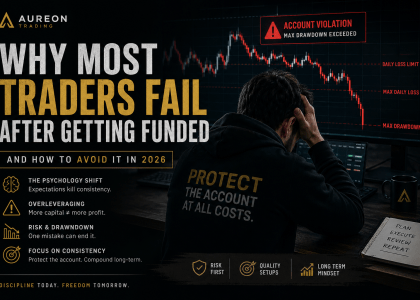


Most traders do not destroy their accounts because they cannot read a chart.
They do it because, at the exact moment discipline matters most, they abandon the plan that was supposed to protect them.
A losing trade becomes an immediate re-entry. A missed setup becomes a forced chase. A strong morning creates enough confidence to double position size, while one frustrating loss turns into an entire afternoon of revenge trading.
These decisions rarely feel irrational in the moment. There is always a justification:
“It still looks bullish.”
“I only need one trade to recover the loss.”
“This move cannot continue without a pullback.”
“I’ll move the stop slightly and give it more room.”
But beneath those explanations is a predictable pattern of self-sabotage.
If your strategy looks profitable in backtesting but disappears when real pressure arrives, the problem may not be your market analysis. It may be your behaviour.
What Does Trading Self-Sabotage Look Like?
Trading self-sabotage is any repeated behaviour that moves you away from your own proven process.
Common examples include:
- Entering before confirmation because you fear missing the move
- Increasing risk after a loss
- Moving a stop-loss further away
- Closing winners early while allowing losers more time
- Taking additional trades after reaching your daily target
- Trading mediocre setups because the market feels too quiet
- Switching strategy after a short losing period
- Ignoring your trading hours or preferred instruments
- Attempting to pass an evaluation in one oversized session
- Continuing to trade after reaching your maximum daily loss
The frustrating part is that most traders already know these actions are damaging.
Self-sabotage is not usually a lack of knowledge. It is the temporary loss of control when uncertainty, money and emotion collide.
The Trading Self-Sabotage Cycle
Most destructive sessions follow a similar pattern:
- You begin with a reasonable plan.
- The first trade loses or leaves without you.
- Emotion replaces patience.
- You take a lower-quality trade to recover or catch up.
- The second decision creates another loss.
- Risk increases as frustration builds.
- The original plan is abandoned completely.
- The session ends with a loss far larger than the first trade required.
The first loss was part of trading.
Everything that followed was optional.
Recognising this cycle is important because the damage rarely begins with one terrible decision. It begins with one small compromise: an early entry, a slightly wider stop or “just one more trade”.
Once the first rule is broken, the remaining rules become easier to ignore.
Why Traders Sabotage Themselves
1. The Need to Be Right
A stop-loss can feel like proof that your analysis was wrong.
Instead of accepting new information from the market, you move the stop, add to the position or search for reasons the trade should still work.
Profitable traders do not need every idea to be correct. They need incorrect ideas to remain inexpensive.
The purpose of a stop is not to declare that you are a bad trader. It simply marks the price at which the original setup is no longer valid.
2. The Urgency to Recover Losses
After losing £100, many traders stop asking whether the next setup is valid.
Their new objective becomes making £100 back.
That subtle change is dangerous. The market is no longer being traded according to structure, liquidity or confirmation. It is being used to repair an emotional wound.
The market does not know what you lost, and it does not owe you an immediate recovery.
3. Fear of Missing Out
Watching price move without you can feel worse than taking a planned loss.
This creates late entries, poor risk-to-reward ratios and trades placed far away from logical invalidation levels.
Missing a move costs nothing. Chasing it can cost both money and confidence.
A setup that has already left without providing your entry is not unfinished business. It is simply a trade that did not belong to you.
4. Overconfidence After Winning
Self-sabotage does not only appear after losses.
A strong winning streak can create the belief that you are seeing the market more clearly than usual. Position sizes increase, lower-quality setups become “good enough”, and daily targets are ignored because another win feels inevitable.
Confidence is useful. Invincibility is expensive.
Your risk rules should remain unchanged whether you have lost three trades or won ten.
5. Boredom and the Need for Action
Trading can involve long periods of doing nothing.
For traders conditioned to associate effort with activity, waiting can feel unproductive. They begin searching across timeframes, inventing setups or entering before confirmation simply to feel involved.
But trading is not paid by the hour or by the number of orders placed.
Sometimes the most professional decision of the day is closing the platform without taking a trade.
Why Prop-Firm Trading Magnifies the Problem
Prop-firm evaluations add another layer of psychological pressure.
The profit target is always visible. The drawdown is always nearby. Traders start calculating how many days it could take to pass, how much they could withdraw and what the next account might be worth.
The account stops being treated as a risk-management exercise and becomes a ticket to a different life.
That emotional attachment encourages traders to rush.
A £50K account is not £50,000 of disposable trading capital. The amount that matters is the permitted drawdown. If the account has a £2,000 loss allowance, that £2,000 must be protected like the entire business depends on it—because it does.
The fastest way to pass an evaluation is not necessarily to reach the target as quickly as possible. It is to remain eligible long enough for your edge to play out.
How to Stop Self-Sabotaging Your Trading
Make Your Rules Binary
Vague rules create room for negotiation.
“Only take good setups” means very little when adrenaline is high. A stronger rule clearly defines what must happen before an entry.
For example:
- Previous session liquidity must be swept
- Price must displace back through the level
- Market structure must confirm the reversal
- Entry must occur on a planned pullback
- A logical invalidation point must be available
- Minimum risk-to-reward must be met
If one required condition is missing, there is no trade.
The decision should be made by the checklist—not by how strongly you want the setup to work.
Define the Loss Before Entering
Before every trade, know:
- Where the trade is invalid
- How much money is at risk
- Whether that risk fits your daily limit
- Where partial profits may be taken
- What would justify closing early
If you cannot accept the planned loss, the position is too large.
Reducing size is not weakness. It is what allows you to think clearly while the position is open.
Introduce a Hard Daily Stop
A daily loss limit prevents one emotional session from damaging an entire week.
Once reached, the platform closes. There is no final attempt, reduced-size recovery trade or “perfect setup” exception.
Where possible, use platform risk settings to enforce the limit automatically. Discipline is easier when your worst impulses do not have access to the order button.
For a deeper risk framework, connect this section to Risk Management That Actually Works: The 0.5% Model.
Limit the Number of Trades
Overtrading becomes harder when the maximum number of attempts is decided before the session.
A trader might allow:
- Two planned trades per session
- One additional entry only if the first trade ended at breakeven
- No immediate re-entry after a full loss
- No new positions after reaching the daily target
The exact number depends on the strategy. The important part is that the limit cannot change halfway through the session.
Use a Pause After Every Loss
A loss creates urgency. Interrupting that urgency helps prevent automatic revenge trades.
After a losing position:
- Step away from the screen.
- Take several minutes without analysing a new entry.
- Screenshot the trade.
- Confirm whether the setup followed your rules.
- Check your remaining daily risk.
- Only return when the next decision can be made independently of the previous result.
The objective is not to eliminate emotion. It is to stop emotion from immediately placing another order.
Score Execution, Not Daily Profit
A profitable day can still contain terrible trading.
You might break your rules, oversize and escape with a win. If that session is recorded as a success, the dangerous behaviour becomes reinforced.
Likewise, a perfectly executed setup can lose. Recording that day as a failure encourages unnecessary strategy changes.
At the end of each session, score yourself on:
- Setup selection
- Entry discipline
- Position sizing
- Stop-loss discipline
- Trade management
- Respect for daily limits
- Emotional control
Profit is an outcome. Execution is the part you can repeat.
Stop Watching the Money
Watching every tick change your open profit and loss makes it difficult to manage a trade objectively.
Where possible, focus on price, structure and invalidation rather than the cash figure flashing beside the position.
Your trade should not suddenly become invalid because £80 of unrealised profit fell to £40. It should become invalid because market information changed.
Build Trust Through Repetition
Confidence does not come from motivational quotes or one large winning day.
It comes from collecting evidence that you can follow your process.
Every correctly executed trade is a vote for the trader you are trying to become. Every session stopped at the correct limit proves that a bad day no longer has the power to become a disastrous one.
The objective is not perfect discipline forever. It is making disciplined behaviour increasingly automatic.
The Aureon Anti-Sabotage Protocol
Before each session:
- Mark the exact liquidity levels and scenarios you are willing to trade
- Set your maximum risk per trade
- Set your maximum daily loss
- Decide the maximum number of attempts
- Check scheduled high-impact news
- Define what would make today a no-trade day
Before each entry:
- Confirm every setup condition
- Calculate the position size
- Place the stop at genuine invalidation
- Accept the full potential loss
- Reject the trade if it requires chasing
After each trade:
- Screenshot the execution
- Record whether the rules were followed
- Pause after a loss
- Do not increase size to recover
- Stop immediately when the daily limit is reached
After the session:
- Grade the process before checking the result
- Identify one decision to repeat
- Identify one behaviour to remove
- Close the platform and let the day end
Simple rules are powerful because they leave less room for your emotional state to rewrite the plan.
Final Thoughts
Trading psychology is not about removing fear, frustration or doubt.
Those reactions are natural when money and uncertainty are involved. The goal is to build a structure in which those emotions are allowed to exist without controlling your decisions.
You do not need to predict every move. You do not need to win back a loss today. You do not need to catch the trade that left without you.
You need to protect your capital, execute your edge and remain in the game.
Self-sabotage ends when keeping your rules becomes more important than satisfying the emotion of the moment.
That change may not produce an overnight transformation—but over hundreds of trades, it can transform everything.
Trading involves substantial risk, and no strategy or psychological framework guarantees profitability. This article is for educational purposes only and does not constitute financial advice.